
Building the Right Thing:
Research-Driven Innovation

Overview
I was a member of the Innovation Team dedicated to transforming early-stage ideas into viable products. Focusing on research, rapid prototyping, and iterative development, we developed a fast-paced research framework that helped us make informed decisions about what to build and how – aligning with real-world demands and company goals.
Our lean team included a product manager, a data analyst, and me as the UX researcher. Our strategic approach focused on:
- Working on disruptive & breakthrough innovations
- Failing fast and adapting quickly
- Measuring innovation efforts
Role
As the team's UX researcher and expert, I worked closely with the product manager to lead and maintain our ongoing research framework.

Process
Inspired by methodologies from books such as The Lean Startup, Discovery Habits, The Mom Test and Innovation Accounting, we developed an iterative research framework based on two-week sprints. Each sprint included the following steps:
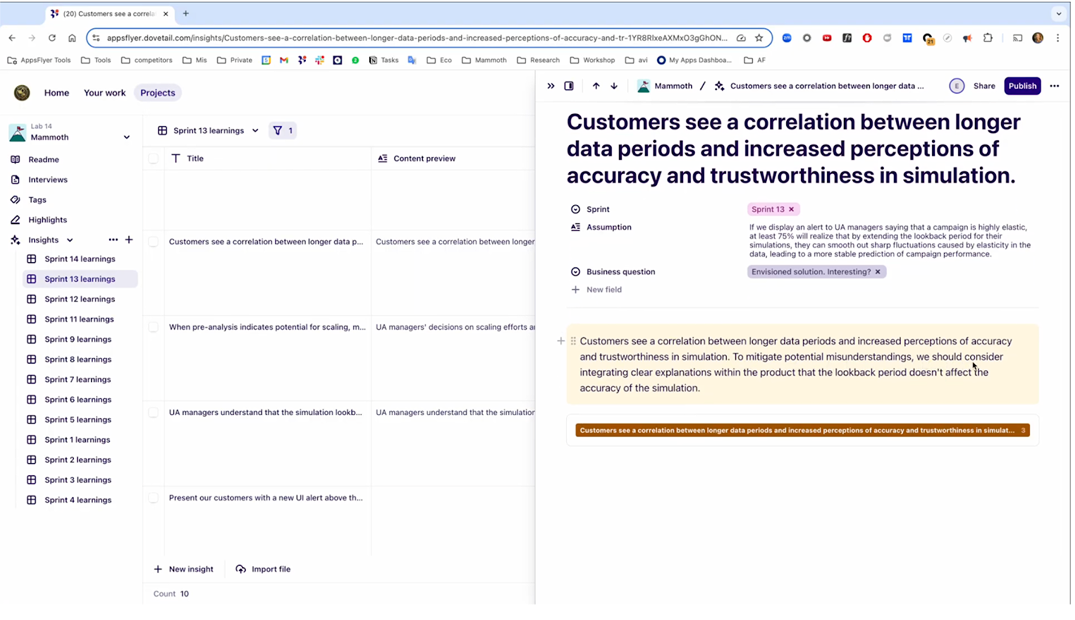
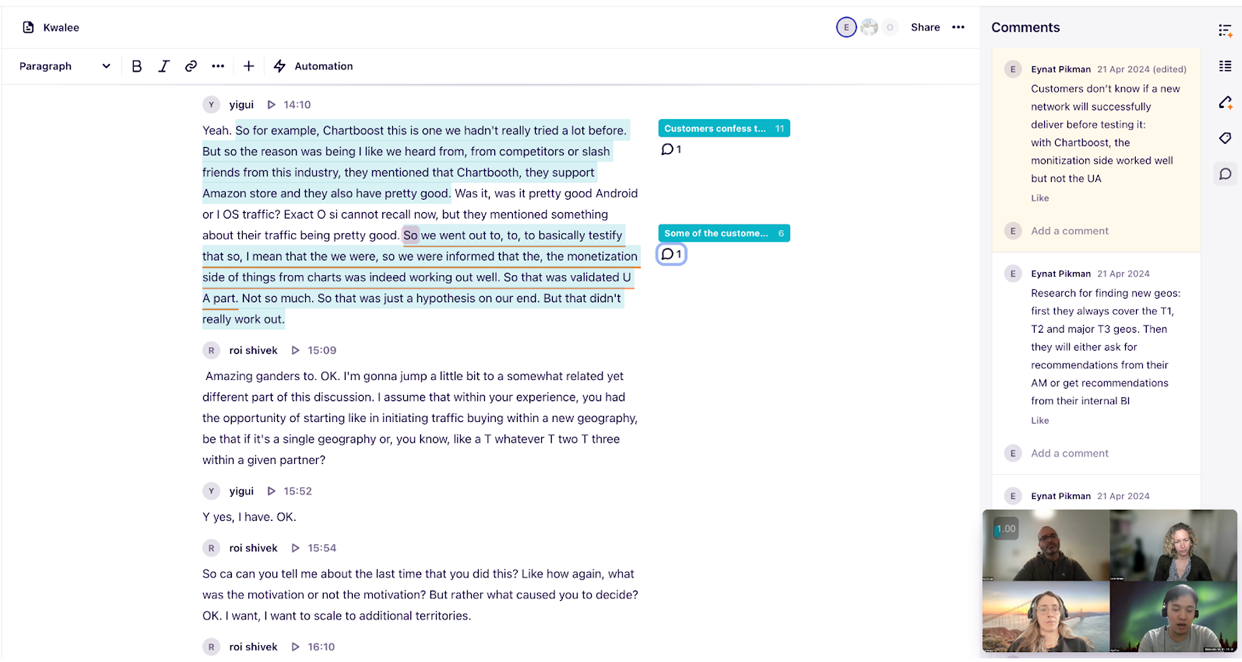
Dovetail - customer interview repository
- At the start of each sprint, the PM and I defined key assumptions and explored ways to test them. I then built quick prototypes to gather real-time feedback during customer interviews.
- After each interview, we debriefed to extract insights. As sessions accumulated, patterns emerged, helping us validate or debunk assumptions.
- I centralized and tagged all research insights, including interview recordings, in Dovetail, a collaborative repository that made findings easy to search, revisit, and share across the team.
[ 1 ]
Selecting a question
Selecting the business question we want to answer according to the product life cycle stage (discovery, exploration...)
[ 2 ]
Making assumptions
Come up with hypotheses to provide potential answers to this question
[ 3 ]
Experimenting to test assumptions
Validating or debunking hypotheses and solutions via interviews with five design partners
[ 4 ]
Extracting actionable insights
Gathering and synthesizing insights and take decisions: Incorporate insight into product or decide to learn more
[ 5 ]
Building confidence to move to the next product phase
Accumulate insights and decide if we learned enough on this question and can move forward
Research framework

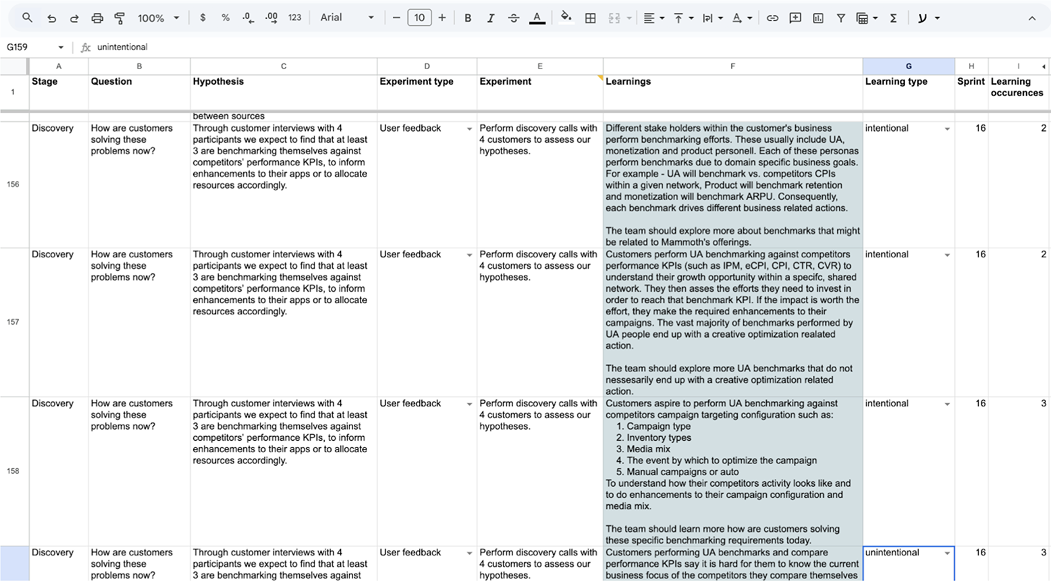
Database of insights
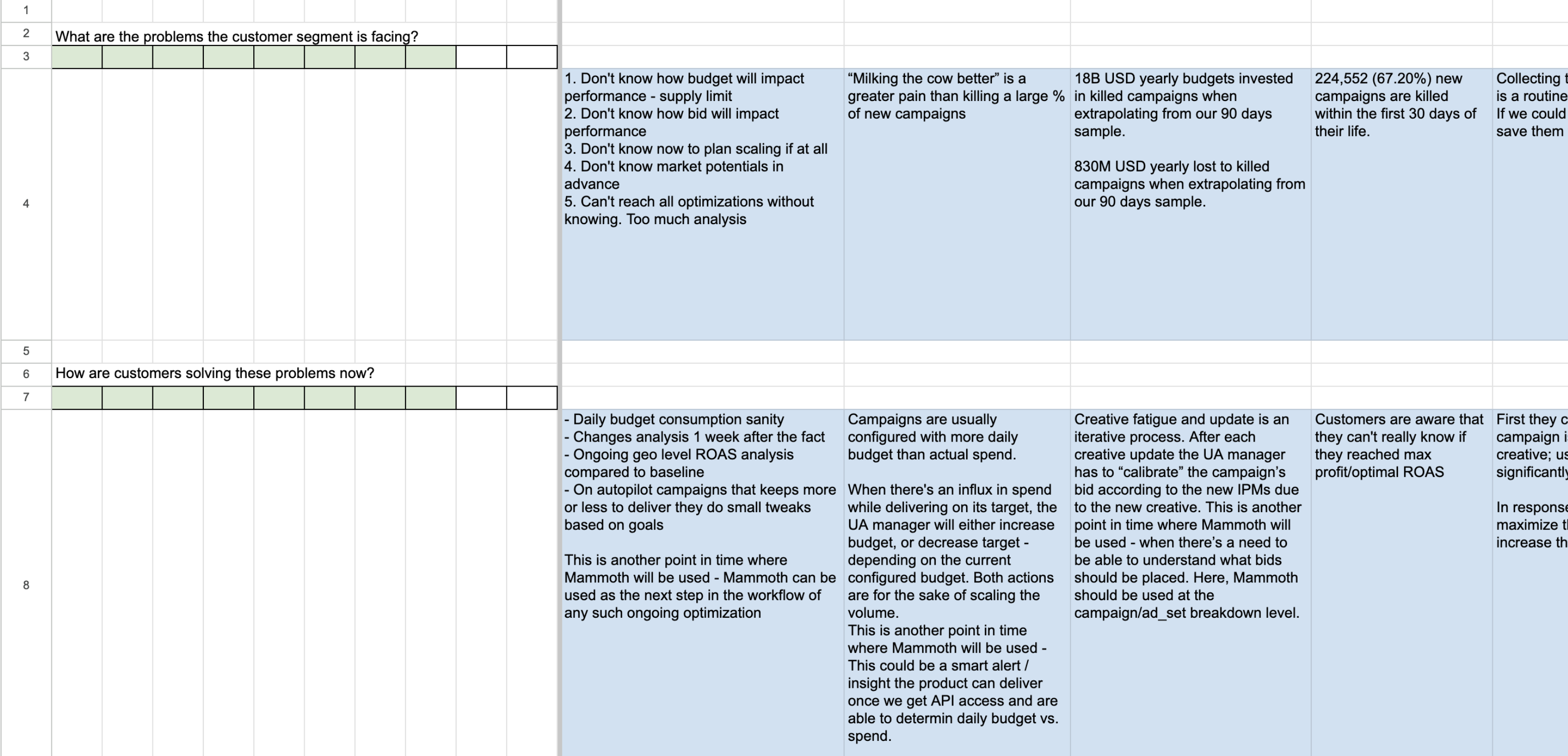
- We built an insights database to map insights to business questions. This helped us filter, cross-reference, and assess whether we had enough understanding to move forward and which insights should we incorporate into our product.
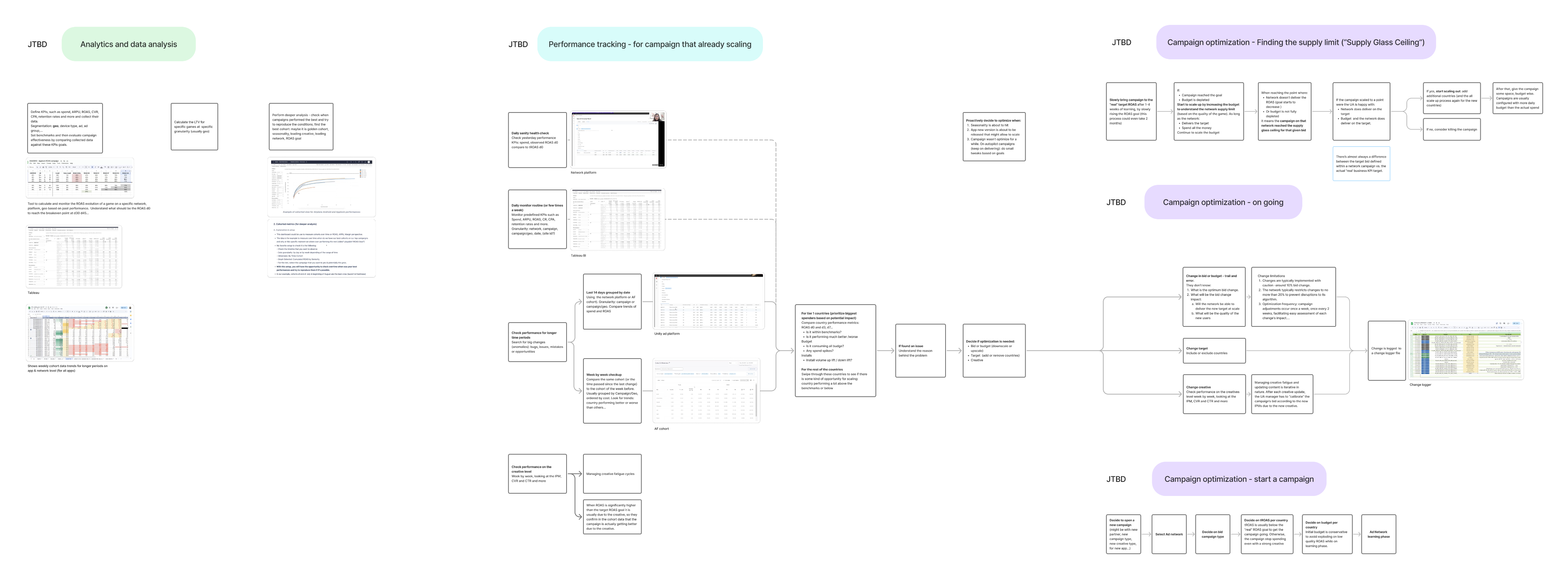
Customer journey map
- I mapped how marketers perform key jobs through a dynamic customer journey map. This map evolved with our understanding and supported additional product initiatives.
- We regularly presented insights to the venture board for review and further guidance, ensuring transparency and alignment.
Reports to the Venture Board

Project impact
Company-wide research training program
Co-Initiated and led a company-wide Research & Innovation training program. Our program consisted of 5 practical sessions in research techniques and methodologies drawn straight from our work, equipping product teams with practical tools to embed user-centered research into their workflows.
Driving better decisions across the organization
The deep understanding we gained of AppsFlyer users’ needs and behaviors not only guided our team but also empowered other product teams to make informed decisions about what to build and how making their work more effective.
Product moves from concept to Beta phase
The main product idea that we were working on, moved to Beta phase. we transformed a vague concept into a functional product that was deeply aligned with marketer needs.

eynat.pikman@gmail.com
+972-52-5866151


Building the Right Thing:
Research-Driven Innovation

Overview
I was a member of the Innovation Team dedicated to transforming early-stage ideas into viable products. Focusing on research, rapid prototyping, and iterative development, we developed a fast-paced research framework that helped us make informed decisions about what to build and how – aligning with real-world demands and company goals.
Our lean team included a product manager, a data analyst, and me as the UX researcher. Our strategic approach focused on:
- Working on disruptive & breakthrough innovations
- Failing fast and adapting quickly
- Measuring innovation efforts
Role
As the team's UX researcher and expert, I worked closely with the product manager to lead and maintain our ongoing research framework.

Process
Inspired by methodologies from books such as The Lean Startup, Discovery Habits, The Mom Test and Innovation Accounting, we developed an iterative research framework based on two-week sprints. Each sprint included the following steps:
Dovetail - customer interview repository
- At the start of each sprint, the PM and I defined key assumptions and explored ways to test them. I then built quick prototypes to gather real-time feedback during customer interviews.
- After each interview, we debriefed to extract insights. As sessions accumulated, patterns emerged, helping us validate or disprove assumptions.
- I centralized and tagged all research insights, including interview recordings, in Dovetail, a collaborative repository that made findings easy to search, revisit, and share across the team.
[ 1 ]
Selecting a question
Identify the business question we want to answer based on the product life cycle stage (discovery, exploration, etc.)
[ 2 ]
Making assumptions
Form hypotheses that offer possible answers to the question
[ 3 ]
Ideating solutions and prototyping
Generate and rapidly prototype multiple solutions to test the hypotheses
[ 4 ]
Experimenting to test assumptions
Validate or debunk hypotheses through interviews with five design partners
[ 5 ]
Extracting
actionable insights
Gather and synthesize findings to inform product decisions or determine the need for further exploration
[ 6 ]
Building confidence to move to the next product phase
Assess whether we’ve learned enough to move forward and identify which insights to incorporate
Research framework
Database of insights
- We built an insights database to map findings to business questions. This helped us filter, cross-reference, and evaluate whether we had enough understanding to move forward, and which insights to incorporate into the product.
Customer journey map
- I mapped how marketers perform key jobs through a dynamic customer journey map. This map evolved with our understanding and supported additional product initiatives.
- We regularly presented insights to the venture board for review and further guidance, ensuring transparency and alignment.
Reports to the Venture Board

Project impact
Company-wide research training program
Co-initiated and led a company-wide Research & Innovation training program. It included five practical sessions covering research techniques and methodologies directly drawn from our work – equipping product teams with practical tools to embed user-centered research into their workflows.
Driving better decisions across the organization
The deep understanding we gained of users’ needs and behaviors not only guided our team, but also empowered other product teams to make informed decisions about what to build and how, making their work more effective.
Product moves from concept to Beta phase
The main product we worked on moved to Beta phase. We transformed a vague concept into a functional product that was deeply aligned with marketer needs.
eynat.pikman@gmail.com
+972-52-5866151
Building the Right Thing:
Research-Driven Innovation

Overview
I was a member of the Innovation Team dedicated to transforming early-stage ideas into viable products. Focusing on research, rapid prototyping, and iterative development, we developed a fast-paced research framework that helped us make informed decisions about what to build and how – aligning with real-world demands and company goals.
Our lean team included a product manager, a data analyst, and me as the UX researcher. Our strategic approach focused on:
- Working on disruptive & breakthrough innovations
- Failing fast and adapting quickly
- Measuring innovation efforts
Role
As the team's UX researcher and expert, I worked closely with the product manager to lead and maintain our ongoing research framework.

Process
Inspired by methodologies from books such as The Lean Startup, Discovery Habits, The Mom Test and Innovation Accounting, we developed an iterative research framework based on two-week sprints. Each sprint included the following steps:
Dovetail - customer interview repository
- At the start of each sprint, the PM and I defined key assumptions and explored ways to test them. I then built quick prototypes to gather real-time feedback during customer interviews.
- After each interview, we debriefed to extract insights. As sessions accumulated, patterns emerged, helping us validate or debunk assumptions.
- I centralized and tagged all research insights, including interview recordings, in Dovetail, a collaborative repository that made findings easy to search, revisit, and share across the team.
[ 1 ]
Selecting a question
Identify the business question we want to answer based on the product life cycle stage (discovery, exploration, etc.)
[ 2 ]
Making assumptions
Form hypotheses that offer possible answers to the question
[ 3 ]
Ideating solutions and prototyping
Generate and rapidly prototype multiple solutions to test the hypotheses
[ 4 ]
Experimenting to test assumptions
Validate or debunk hypotheses through interviews with five design partners
[ 5 ]
Extracting
actionable insights
Gather and synthesize findings to inform product decisions or determine the need for further exploration
[ 6 ]
Building confidence to move to the next product phase
Assess whether we’ve learned enough to move forward and identify which insights to incorporate
Research framework
Database of insights
- We built an insights database to map insights to business questions. This helped us filter, cross-reference, and assess whether we had enough understanding to move forward and which insights should we incorporate into our product.
Customer journey map
- I mapped how marketers perform key jobs through a dynamic customer journey map. This map evolved with our understanding and supported additional product initiatives.
- We regularly presented insights to the venture board for review and further guidance, ensuring transparency and alignment.
Reports to the Venture Board

Project impact
Company-wide research training program
Co-Initiated and led a company-wide Research & Innovation training program. Our program consisted of 5 practical sessions in research techniques and methodologies drawn straight from our work, equipping product teams with practical tools to embed user-centered research into their workflows.
Driving better decisions across the organization
The deep understanding we gained of AppsFlyer users’ needs and behaviors not only guided our team but also empowered other product teams to make informed decisions about what to build and how making their work more effective.
Product moves from concept to Beta phase
The main product idea that we were working on, moved to Beta phase. we transformed a vague concept into a functional product that was deeply aligned with marketer needs.
eynat.pikman@gmail.com
+972-52-5866151